
More On The Wild Life
Skunks and rattlesnakes are also present in the area. If you encounter
one in the middle of the trail, common sense should tell you to stay your
distance until it decides to leave or you can find a safe route around.
Then you can use the encounter to spice up the description of the trip to
the folks back home.
Some wildlife is only wild to those unfamiliar with the area. One group
of ATVers was stopped by a herd of cows on the trail; they turned around
and returned to town. Trail riders must realize that most of the trail system
is on public lands where ranchers have permits to graze their cattle. Consequently,
you may see cattle on practically any part of the trail. They are completely
harmless. When encountering cows on the trail, simply reduce your speed
and continue driving. They will get out of your way. Some cows may even
think you are there to herd them and stay on the trail ahead of you for
some time. Be patient, they will eventually get out of your way. On the
other hand, remember that these cows are someone's property, so do not harass
then unnecessarily.
Because there is grazing, there are gates along the trail separating
pastures or land ownerships. Always leave these gates as you find them;
open if you find them so, or closed if they were closed when you arrived.
On many parts of the trail gates are being replaced by cattle guards, some
especially designed for ATV's, to make your trip easier.
At places the Paiute Trail passes through private land. All of the main
loop and some of the side loops follow legal rights-of-way across these
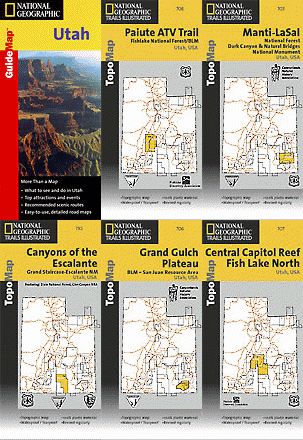
parcels of private land. The travel management map for the Fishlake National
Forest shows the location of these rights-of-way. It also shows areas of
the Forest that are closed or restricted to motorized travel to protect
wildlife habitat, watershed condition, or recreation opportunities. When
crossing private land on a right-of-way, remember not to trespass on someone
else's property.
There are several factors that should be considered that are due to the
high elevation of the trail. As pointed out above, elevations along the
trail range from 5,000 to 11,500 feet above sea level. The factor of the
late summer riding season has been discussed above. A second factor caused
by the elevation is the rare atmosphere and low oxygen levels. People with
respiratory problems or a heart condition should consult a doctor before
leaving home. Also people coming directly from near sea level must be aware
that their physical stamina will be limited until they become acclimatized.
A third factor caused by the rare atmosphere at the trail's high elevations
is temperature fluctuations. First, with over a mile of relief between high
and low points of the trail, there can be a 20 to 30 degree temperature
difference along the trail. Second, it is common to have a 40 degree temperature
change from morning to night. This diurnal fluctuation especially must be
considered by those planning to camp along the trail. Along with these temperature
fluctuations is the fact that it never really gets too warm at 11,000 feet.
As a result you should always carry warm clothing even if the weather appears
mild at the start of a ride.
Pre planning is the key to a successful trip. Once you embark on the
trail, you are in a different world with few support services. It is important
that you have everything that you might need. This includes having enough
fuel to get from one filling station to the next. The trail system is so
extensive that even though there may be hundreds of people riding the trail
at the same time, you may go for hours or even all day without meeting anyone.
If you are planning to camp, you will need tents, stoves, sleeping bags,
lanterns, food, etc. There are plenty of camping spots along the trail.
Campfires are permitted except during periods of extreme fire danger. Burn
only dead and down wood, make sure the fire is completely out before you
leave, and clean the campsite so it looks as if no one has been there.
If you are planning to stay in motels, plan how far you in tend to travel
each day and then make reservations. Most of the towns along the trail are
small and motel accommodations are extremely limited. Eating establishments
are also limited in the smaller towns. Learn the hours of operation of local
cafes ahead of time. You also might want to learn ahead of time where ATV's
can be repaired should you have trouble.
If this booklet does not answer all of your questions you should contact
the Fishlake National Forest, the Richfield office of the BLM, a local chamber
of commerce, or travel council. They will be able to give you additional
information, answer specific questions, or direct you to the pro per source.
Government agencies, such as the Forest Service or the BLM, cannot recommend
individual private businesses. To get advice on motels, ATV rentals, etc.,
you should contact a local chamber of commerce or travel council.
continued next page


















 [
[